

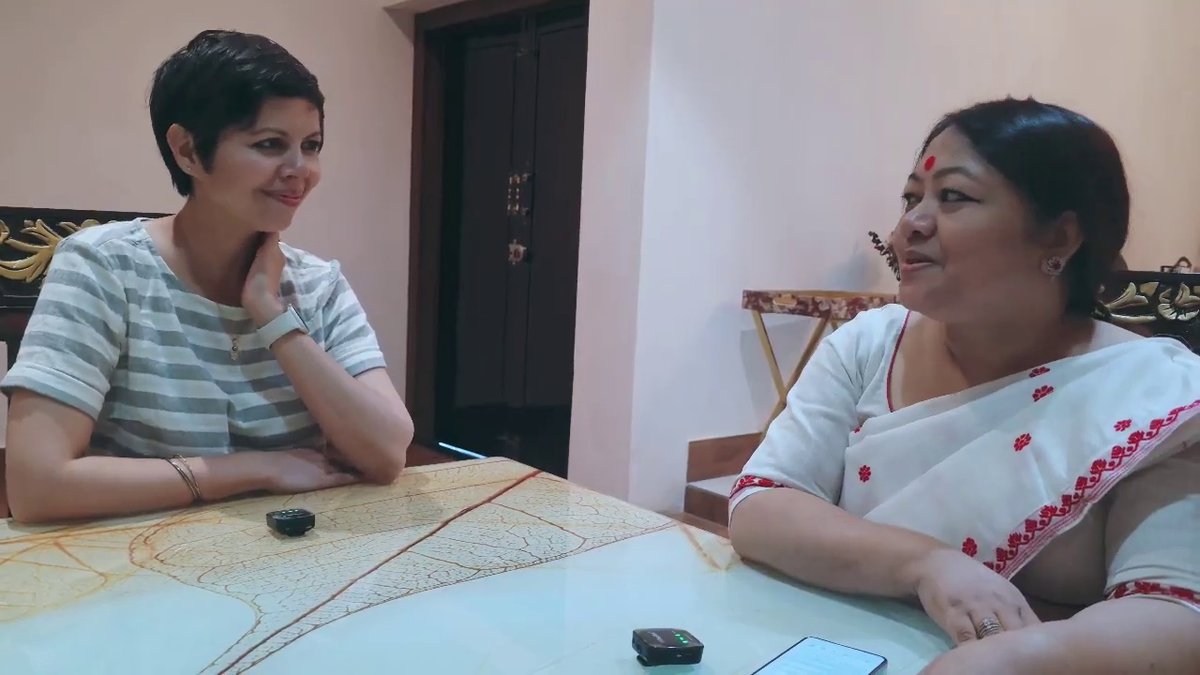
Janice Pariat — writer, poet, and author of Boats on Land, Seahorse, The Nine-Chambered Heart, and Everything the Light Touches — teaches Creative Writing and History of Art as an Assistant Professor at Ashoka University. A graduate of St. Stephen's College, Delhi University, she holds Master's degrees in History of Art from SOAS, University of London, and in English and Communications from the University of Westminster. Her work has appeared in The Hindu, The Indian Quarterly, Verve Magazine, The Caravan, and The Print, and she writes "Paperwallah," a monthly literary column for The Hindu. In this conversation with Ananya Hiloidari — who has translated Everything the Light Touches — Pariat reflects on the landscapes that made her a writer, the journey away from home and back, and the questions that run like a spine through all her books.
A Childhood of Two Landscapes
Born in Jorhat and most often described as a writer from Shillong, Pariat insists her childhood belonged to both hills and plains. Her early years moved with her parents through some of Assam's most beautiful places — North Lakhimpur, Margherita, Tezpur — before the hills claimed her too.
"I'm so fortunate that I have these landscapes in my life. My writing is inspired by the vast plains of Assam, by the vast skies of Assam, but also by the high mountains of Meghalaya."
More than scenery, though, it was people. In both Assam and Shillong she grew up inside a community of storytellers — "the greatest gift that a writer can receive, because storytellers teach you how to listen and how to write." Without them, she says, she would never have become a writer at all.
Leaving in Order to Return
Her education carried her outward — St. Stephen's in Delhi, then London. Asked how that shaped her, she named a tension familiar to everyone raised in the Northeast: elders who say you have to get out, that there is nothing here amid the trouble and political turbulence, so that many migrate believing there is little to come back to. Much of her writing, she says, has been an attempt to remake that narrative — because hidden inside the leaving was the return.
"In my going away from home also lay the return home. That journey can only happen when you have left. And that return is not just physical — it is a turning of the gaze. You start thinking about the stories closest around you, the stories you have to unearth, because your history never really taught you the history of what was around you."
The going away mattered too: it taught her the world is "inexplicably large but also inexplicably connected." Both movements, she insists, were essential.
"The Stories Choose You"
Fiction or poetry, story or novel — which identity does she prefer? She laughed off the question: "I feel like the stories choose you. I step into the energy of a story, if I am fortunate enough, and that story is revealed through me." Form, in that process, is built rather than inherited:
"It's not like a house that already exists and you step in through the door. Form is something you build, one brick at a time, so that it takes the shape it needs to. Form is precarious — it is not a given."
What interests her are entanglements — "how beautifully messy things are" — and a writing allowed to be all the things it needs to be.
One Question, Four Books
Her books look disparate, but Pariat sees a single thread: a persistent questioning of categories. "We as humans are very fond of boxing and labelling — we do that with identity, with religion, with gender, with nationality. We prefer things neat, and life doesn't work that way." Boats on Land asks who is an insider and who an outsider; Seahorse asks who decides your gender, insisting it is a fluid spectrum; The Nine-Chambered Heart asks how identity is built — are we who we tell ourselves we are, or the stories others tell of us, and who gets to decide?
Everything the Light Touches is her most persistent resistance yet, taking the question down to the roots of knowledge itself: "How do we know what we know? Are we going to learn through division, or through integration? Through categorisation, or through unity — recognising interconnectivity?" Botany became the vehicle — hard-won, since she was never a science student: the novel demanded four to five years of reading from scratch, learning traditional science "in order to be able to then critique it."
Goethe's Primal Plant and Indigenous Knowledge
The novel's boldest architecture pairs Goethe's botanical quest with a mythical primal plant sought in the hills of the Northeast. She needed a symbol of unity that resisted all division, and found it in Goethe's Urpflanze — "the primeval plant, the plant that is all plants... the most potent metaphor for the idea that everything is connected." But it was crucial that the novel's own quest, pursued by Evie and enveloped by Shai's story, unfold among indigenous communities:
"Indigenous ways of looking at the world are something we must return to if we wish to claw our way out of this ecological mess. The idea Goethe had in the late 1700s has been with indigenous people for centuries longer. And Goethe was a white European man — even he was dismissed. You can imagine, then, what happens to indigenous ideas. I wished to place them in conversation."
Editors, and a Word for New Writers
On editing, Pariat places herself happily among writers who welcome it — provided the editor is one she deeply trusts. In Rahul Soni she found an editor "who has a vision for the book that perhaps even I hadn't imagined," pushing her toward something larger; the editing process, she says, is where a book is elevated and polished.
Asked what advice she would give the young writers and poets of Assam, she demurred — "Who am I to advise anybody?" — before passing on the advice once given to her:
"No one else can tell your story. There is no one else who has experienced the things that you have, no one else who emerges from your context in the way that you have. I thought that was so bolstering, because it gives you faith in what you have to say."
It could stand as a summary of her whole body of work — which keeps insisting, book after book, that the stories closest to home are the ones the world most needs to hear.
Quotations have been lightly edited for clarity from the recorded conversation.
Watch the full conversation: In Conversation: Ananya Hiloidari and Janice Pariat on Writing and Life