

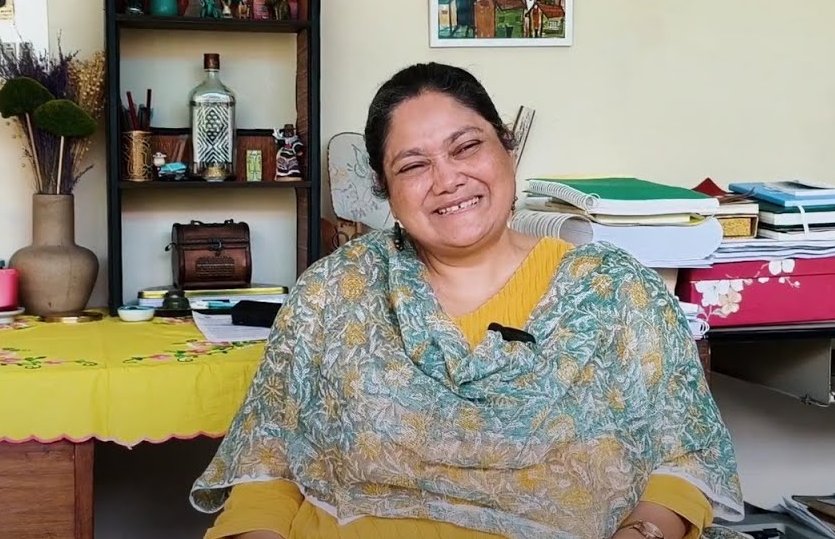
Moushumi Basu traces her love of learning to her father, who came to India as a refugee and raised three daughters on one conviction: the only thing he could give them was not wealth, but the ability to stand on their own feet. Childhood meant focused study — half an hour was enough — and a bedroom bookshelf that became a constant companion, teaching her to understand the world beyond the family. From Hindu College, Delhi, she chose JNU's School of International Studies deliberately: Indian IR, she felt, was directed by state narratives, and she wanted a people's history of the discipline, which led her to specialise in development.
Teaching Without Fear
After more than twenty years of teaching, Basu remains critical of a schooling system built on rote learning, where universities become the first spaces students are expected to think — beginning with the question, why am I studying at all? Her classroom method is collegial: drawing out shy students, encouraging expression without fear.
"Right now people are very cagey about expressing what they feel, and I think that's not good for a country — especially a country where, in Tagore's words, you have to have a mind which is not fearful, a mind which thinks. Yet we do so little to cultivate that in our students."
Teaching international organisations, she refuses realism as a starting point — states do benefit from cooperation — while acknowledging power frankly, as when she shows students how the Bretton Woods system institutionalised weighted voting alongside the UN's sovereign equality. And her utopia is disarmingly minimal: in a country where daily-wage earners must fight for legally mandated minimum wages, she asks, "Is that a utopia?" We must put our imaginings into practice.
Feminism as a Living Experience
Asked to define feminism personally, she begins at home — "my whole family is a feminist" — insisting our first lessons should come from the family itself. Feminism means equality, dignity, and questioning the created norms that assign roles to women and men at birth. It is also her research method: recognising the family as a unit of power, noticing how census-takers record the father as head of household without asking, talking to the woman as well as the man in the field. On Foucault's docile bodies, she points to cinema's blame-the-victim narratives and to institutions — even courts — that encourage a soft, docile womanhood:
"Why do hostels say all women must report back by 9? You're adults. You can vote for a prime minister, but the prime minister can't ensure your safety on the streets — and so you need women back in the hostels?"
Culture, Commerce, and Documentation
On tribal and regional cultures under pressure from dominant meta-cultures, her first prescription is documentation of social history — like Bihar's women who weave sikki grass into baskets where they once made idols — so that barriers between elite and subaltern art break down. Subnationalism, she argues, must be diagnosed, not dismissed: ask why recognition and participation are denied — as with Uttarakhand and Telangana — while guarding against capture by subnational elites. She is equally unsparing about commercialization, from coaching centres hollowing out schools to paid queues at temples, and reality shows that reduce art, once woven into everyday life, to a monetizable skill. A lifelong bilingual reader — from Sukumar Ray's Abol Tabol to Mahasweta Devi in the original, at her mother's prodding — she accepts reproduction of art as democratization (a Husain postcard she can own) but not as merchandise: "I don't think I want to wipe my hands on a Gandhi tissue paper."
Migration and Our Lost Sensitivities
On undocumented migration — the question closest to Assam — Basu begins with why people are forced to move, and with the stillborn Inter-State Migrant Workmen Act, never enforced and now repealed, leaving workers at contractors' mercy. Against the manufactured narratives around the "so-called Bangladeshi," she sets a constitutional floor: Article 21 protects foreigners as well as citizens, and international law forbids return while persecution threatens.
"The crisis here is that we are moving away from being a very humane society. We are losing our sensitivities. Today it is the Rohingya; tomorrow it may be somebody else — somebody within your own citizenship who is looked upon as the other. That is the danger."
Her proposal is practical: if we already use migrant labour, and already keep an open border with Nepal, why not a recognised system of regional labour mobility — recorded, dignified, with no sword hanging over anyone's head? She acknowledges Assam's anxieties over jati and mati, but insists the conversations cannot be left to politicians; people must begin them.
The Soul of JNU
She closes with the university that shaped her — residential, intimate, a mini-India built through deprivation points that brought first-generation students from backward districts, where education lived in dhabas and poster-covered walls as much as classrooms.
"A university space has to be like a garden — it has to encourage all sorts of plants to grow. It shouldn't be a monoculture. We come in as saplings, we grow into trees and learn to stand tall. And that standing tall is not limited to a PhD. It's for life."
Quotations have been lightly edited for clarity from the recorded conversation.
This interview is an initiative of Tezpur Sahitya Sabha in collaboration with Nagaon's independent bookstore The Book Nook, as part of their series of talks and lectures. Aditya Ankur speaks with Moushumi Basu, Associate Professor at the Centre for International Politics, Organisation and Disarmament, JNU, about her academic journey, teaching, and research on politics, culture, and identity, as well as her views on gender, migration, art, and the books that have shaped her thinking. Quotations lightly edited for clarity. Watch the full conversation: Exploring Gender, Migration, and Culture: A Conversation with Prof. Moushumi Basu.