

Contents
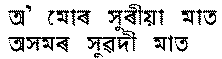
Oh, My Musical Tongue
The Lyrical Voice of Assam
Introduction
Assamese (অসমীয়া, Asamiya) is an Eastern Indo-Aryan language spoken primarily in the Indian state of Assam and adjoining regions of Northeast India. It serves as the official language of Assam and functions as the principal lingua franca among many of the state's diverse ethnic communities. According to the 2011 Census of India, Assamese is spoken by over 15 million people as their mother tongue, while many more use it as a second language across the Brahmaputra Valley and neighbouring areas (Government of India, 2011).
Among the Indo-European languages, Assamese occupies a distinctive geographical position as the easternmost major Indo-Aryan language, representing the eastern limit of the Indo-European language family in South Asia. Its location at the crossroads of South Asia and Southeast Asia has profoundly shaped its linguistic development, resulting in a language that combines an Indo-Aryan grammatical foundation with significant influences from Tibeto-Burman, Austroasiatic, and Tai languages.
Historical Development
The Assamese language evolved from Magadhi Prakrit through Kamarupi Prakrit, the regional vernacular of the ancient kingdom of Kamarupa (c. 4th–12th centuries CE). Although its ultimate roots lie in Sanskrit, Assamese developed independently over many centuries, acquiring distinctive phonetic, grammatical, and lexical characteristics.
The earliest linguistic evidence of Assamese is found in the Kamarupa inscriptions dating from the fifth to the twelfth centuries. However, the earliest specimens of literary Assamese appear in the mystical verses known as the Charyapadas (c. 8th–12th centuries), composed by Buddhist Siddhacharyas. While these verses are shared with the literary traditions of Bengali and Odia, linguistic analysis identifies several features characteristic of early Assamese.
A continuous literary tradition became firmly established from the thirteenth and fourteenth centuries, particularly with the works of Madhava Kandali, whose Assamese translation of the Ramayana is among the earliest vernacular renderings of the Sanskrit epic in any modern Indo-Aryan language. This period marks the beginning of an uninterrupted history of Assamese literature.
Linguistic Characteristics
Assamese belongs to the Eastern Indo-Aryan subgroup of the Indo-European language family. It shares common ancestry with Bengali, Odia, Maithili and other eastern Indo-Aryan languages, yet possesses numerous distinctive characteristics.
Among its most notable phonological features are:
- the absence of the dental–retroflex distinction found in many Indo-Aryan languages;
- extensive use of velar and uvular fricative sounds represented by the letter x (ক্ষ/খ-like pronunciation);
- comparatively simple vowel harmony;
- extensive borrowing from neighbouring language families.
Its grammar retains many inherited Indo-Aryan features while also exhibiting innovations likely resulting from prolonged contact with Tibeto-Burman languages.
Influence of Indigenous Languages
Unlike many Indo-Aryan languages that developed in relatively homogeneous linguistic environments, Assamese evolved amid continuous interaction with indigenous communities inhabiting the Brahmaputra Valley.
The languages of the Bodo-Kachari, Karbi, Mising, Dimasa, Deori, Rabha, Tiwa, and several other Tibeto-Burman-speaking groups have contributed vocabulary, phonetic features, place names, and syntactic influences. Later contact with the Tai Ahoms, who established political dominance in Assam in the thirteenth century, introduced administrative, military, agricultural, and cultural terminology into Assamese.
Consequently, Assamese represents one of the most linguistically diverse Indo-Aryan languages, reflecting centuries of cultural interaction between Indo-Aryan, Tibeto-Burman, Tai, and Austroasiatic traditions.
Literature and Cultural Importance
Assamese possesses one of the oldest literary traditions among the modern languages of eastern India. Its literary heritage spans nearly a millennium and encompasses devotional literature, historical chronicles (Buranjis), poetry, drama, philosophy, folklore, and modern fiction.
The Ekasarana Vaishnava movement, initiated by Srimanta Sankardeva (1449–1568), transformed Assamese into the principal medium of religious and cultural expression. Sankardeva and his disciple Madhavdeva enriched the language through devotional songs (Borgeets), dramatic literature (Ankiya Naat), translations of religious texts, and philosophical writings. Their contributions established Assamese as both a literary and liturgical language.
During the Ahom period (1228–1826), official chronicles known as the Buranjis documented political, diplomatic, military, and social history, providing one of South Asia's richest indigenous historical traditions.
The nineteenth century witnessed the Assamese literary renaissance, led by figures such as Anandaram Dhekial Phukan, Hemchandra Barua, Lakshminath Bezbaroa, and later Jyotiprasad Agarwala, Birinchi Kumar Barua, Homen Borgohain, Indira Goswami, and many others.
Modern Status
Assamese is the official language of the Government of Assam and serves as the primary language of administration, education, literature, journalism, broadcasting, and electronic media across much of the state.
It is taught in schools and universities, supported by institutions such as the Assam Sahitya Sabha, Asam Publication Board, Gauhati University, and Dibrugarh University. Newspapers, television channels, digital media, and an expanding body of online publications continue to strengthen its role in contemporary society.
The language is also spoken by diaspora communities across India as well as in North America, Europe, Australia, and Southeast Asia.
Research and Scholarship
Modern linguistic scholarship recognises Assamese as an important language for understanding the evolution of Eastern Indo-Aryan languages and the processes of language contact in Northeast India.
Its development illustrates how prolonged interaction among Indo-Aryan, Tibeto-Burman, Tai, and Austroasiatic populations produced a distinctive linguistic system. Studies in historical linguistics, sociolinguistics, comparative philology, and manuscript traditions continue to expand knowledge of Assamese and its role within the cultural history of Northeast India.
References
- Census of India 2011. Office of the Registrar General & Census Commissioner, Government of India.
- Grierson, G. A. (1903–1928). Linguistic Survey of India, Vol. V.
- Goswami, Golock Chandra. An Introduction to Assamese Phonology. Gauhati University.
- Goswami, Upendranath. A Study on Kāmrūpī: A Dialect of Assamese.
- Kakati, Banikanta. Assamese: Its Formation and Development. Gauhati University, 1941.
- Neog, Maheswar. Early History of the Vaiṣṇava Faith and Movement in Assam.
- Sharma, Satyendra Nath. A Critical Survey of Assamese Literature.
- Baruah, S. L. A Comprehensive History of Assam.
- Chatterji, Suniti Kumar. The Origin and Development of the Bengali Language (comparative discussion of Eastern Indo-Aryan languages).