

Location: Tezpur, Sonitpur district, Assam
Type: Hillock, legendary site and public park
Associated with: The legend of Usha and Aniruddha; Banasura's fortress
Overlooks: The Brahmaputra river
Contents
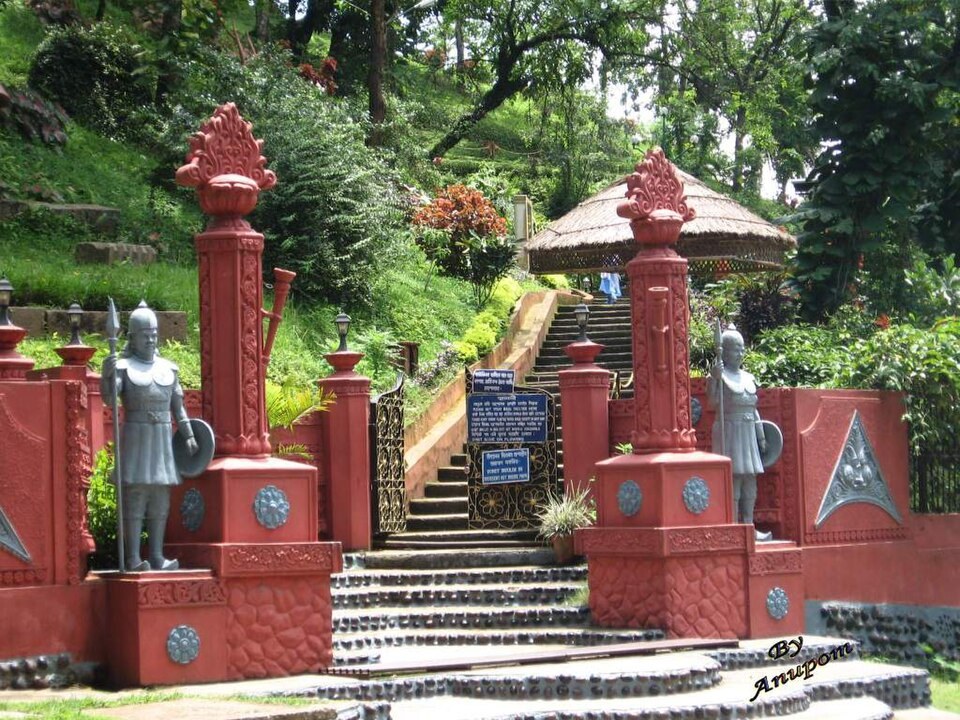
Agnigarh is a small hillock on the southern edge of Tezpur, rising above a bend of the Brahmaputra in Assam's Sonitpur district. Its name is a compound of two words — agni, fire, and garh, fortress — and it carries one of the most persistent legends in Assamese folk memory. Today the hill is a landscaped park, reached by a spiral stairway, with sculpted panels retelling the story that gave it its name and one of the finest river views in upper Assam.
The legend of Usha and Aniruddha
The story belongs to the Puranic cycle surrounding Banasura, a powerful asura king and a devotee of Shiva, who is said to have ruled this stretch of the Brahmaputra valley from a capital called Sonitpur. Banasura had a daughter, Usha. Warned that her marriage would bring about his downfall, he confined her to a fortress and had it encircled by a perpetual ring of fire so that no man could approach — the fortress of fire from which the hill takes its name.
Usha, the story goes, dreamed of a young man and woke unable to forget him. Her companion Chitralekha, a gifted artist, drew portraits of princes and noblemen until Usha recognised the face in her dream: Aniruddha, grandson of Krishna, of the Yadava house at Dwarka. Chitralekha, who possessed supernatural powers, travelled to Dwarka and carried the sleeping Aniruddha back through the air to Usha's chamber, past the flames.
When Banasura discovered the young man inside the fortress, he had him seized and bound. Krishna came from Dwarka to free his grandson, and the confrontation that followed was not merely between two armies. Banasura's devotion had earned him Shiva's protection, and Shiva took the field on his behalf — setting Vishnu, in the form of Krishna, against Shiva himself. Assamese tradition remembers this as the Hari-Hara Yuddha, the battle of Hari (Vishnu) and Hara (Shiva).
Why the town is called Tezpur
The battle is the traditional explanation for the town's name. So much blood was said to have been shed across the plain that the ground itself was stained red, and the place came to be called Tezpur — from tez, blood, and pur, town. The older name preserved in the legend, Sonitpur, carries the same sense: sonit also means blood.
The other name Tezpur has acquired is gentler. Because of Usha and Aniruddha, the town is often called the city of eternal romance, and the legend surfaces everywhere in its civic life — in the name of Chitralekha Udyan, the park at the town's centre, and in the way Agnigarh itself is presented to visitors.
The site today
Agnigarh is now a maintained public garden. A spiral stairway climbs the hillock, and along the path a series of stone and cement sculptures depict episodes from the legend — Usha in confinement, Chitralekha with her portraits, the abduction of Aniruddha, the battle. The sculptures are modern interpretive work rather than antiquities, and are best read as the town telling its own story rather than as archaeological remains.
From the top the ground falls away to the Brahmaputra. The river here is wide and slow, and on a clear day the Kolia Bhomora Setu — the road bridge that carries traffic across to Nagaon district — is visible downstream. The view is the practical reason most visitors climb the hill, and late afternoon, when the light comes low across the water, is the time to do it.
Reading the site: legend and history
It is worth separating the two layers that meet at Agnigarh. The Usha–Aniruddha story is legend — a Puranic narrative attached to a local landscape, of the kind found across India, and there is no archaeological evidence of a fire-ringed fortress on the hill.
The historical layer is a different matter and is genuinely substantial. Tezpur and its immediate surroundings hold some of the most important early sculptural and architectural remains in Assam, associated with the Salastambha dynasty and the wider Kamarupa period. The doorframe at Da-Parbatia, a short distance west of the town, is generally regarded as the finest surviving example of early Gupta-influenced stone carving in the region. The ruins on Bamuni Hills, on the eastern side of Tezpur, preserve carved panels of comparable quality. Both are older, and archaeologically far more significant, than anything at Agnigarh itself — but Agnigarh is the site that holds the town's imagination.
Nearby
- Chitralekha Udyan (Cole Park) — the central town park, named for Usha's companion, with a lake and relocated stone sculptures
- Bamuni Hills — ruined temple remains with carved panels from the Kamarupa period
- Da-Parbatia — the early stone doorframe, among the oldest surviving carved architecture in Assam
- Mahabhairab Temple — a major Shiva temple on the northern side of Tezpur
- Padum Pukhuri — a lake with an island garden, within the town
- Kolia Bhomora Setu — the Brahmaputra road bridge, named for the Ahom general Kolia Bhomora Phukan
Getting there
Agnigarh sits on the southern edge of Tezpur town, a short drive or auto-rickshaw ride from the centre. Tezpur is on the north bank of the Brahmaputra, connected to Guwahati by road, and has its own airport at Salonibari. The site is open through the day and charges a small entry fee.
References
- Scribes remember Dipak Mahanta — https://assamtimes.org/article/scribes-remember-dipak-mahanta-15945 (Assam Times)
- Commemorative meeting at press club — https://assamtimes.org/article/commemorative-meeting-at-press-club-15931 (Assam Times)
- New film on Kanaklata — https://assamtimes.org/article/new-film-on-kanaklata-15455 (Assam Times)